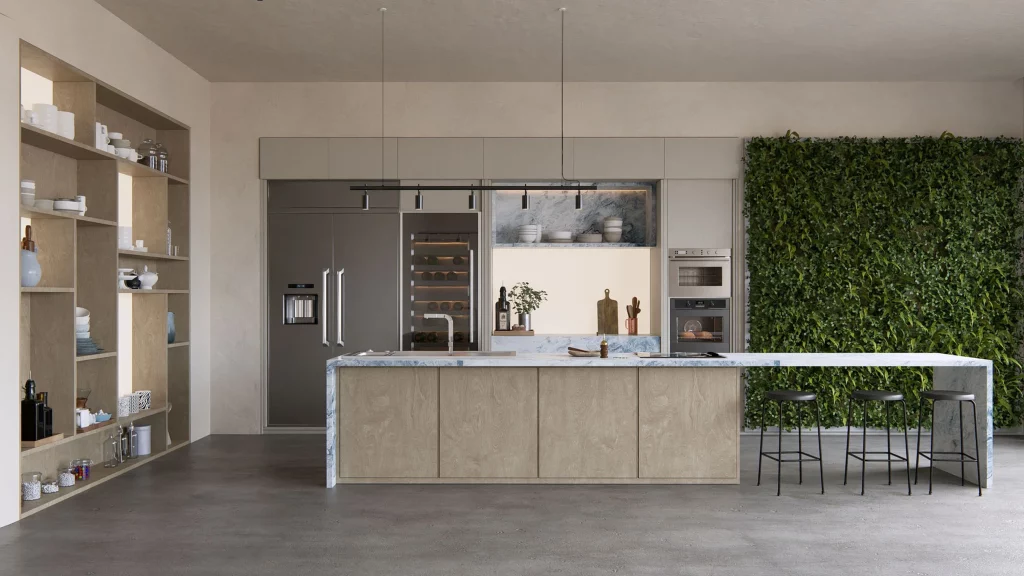
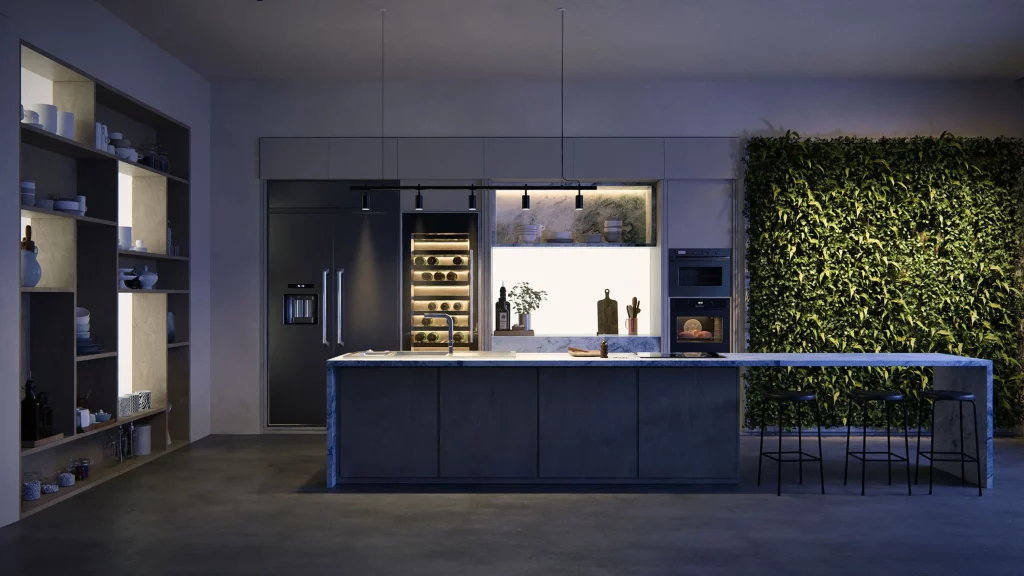
There’s a conversation that’s repeated in architecture studios around the world. The team has worked for weeks on a project. The design is solid, the plans are impeccable, the technical documentation is flawless. And yet, when it comes time to present it to the client, the response is lukewarm. “It’s fine, but I’m not entirely convinced.” Or worse: polite silence and a decision delayed for weeks.
The problem, almost always, is not the project. It’s how it’s presented.
A client who isn’t an architect doesn’t read blueprints. They don’t interpret sections. They don’t mentally reconstruct a space from an axonometric drawing. What the client sees—and what inspires or undermines their confidence in making a decision—is the visual representation. And if that visual representation fails to convey the atmosphere, the materials, the light, and the scale of the proposed space, even the most brilliant project in the world can lose out to a mediocre proposal presented with better visualizations.
This article isn’t about technology for technology’s sake. It’s about understanding what makes an architectural visualization truly convincing, what the most common mistakes are that cause renders to fall short, and how tools like Lumion allow you to bridge that gap without turning every presentation into a weeks-long production project.
Rendering as a sales tool, not just a representation tool
The first necessary change in mindset is this: a rendering is not just a technical representation of the project. It is a communication and sales tool.
A blueprint communicates information to another professional who knows how to read it. A rendering communicates an experience to someone who has to make an important emotional and economic decision. These are two completely different functions that require different approaches.
When a developer is considering investing in a residential project, they’re not thinking about the building’s floor area ratio. They’re thinking about whether the building will attract buyers, whether the terrace looks spacious enough, and whether the afternoon light will justify the premium price of the top-floor apartments. If the rendering doesn’t answer these questions visually and intuitively, it’s not fulfilling its purpose.
When a private client commissions a home renovation, they need to visualize the space before giving their approval. They need to feel that the architect understands how they want to live there. A cold rendering, with flat materials and generic lighting, doesn’t create that feeling. A rendering that captures the warmth of the morning light streaming through the north-facing window and the exact tones of the chosen finishes does.
Visual quality is not an aesthetic luxury. It is the mechanism by which the client goes from “I understand the project” to “I want this project.”
Why many renders fail to convince even if they are technically correct
There’s a gap between technically accurate renders and those that truly captivate clients. Identifying that gap is the first step to closing it.
The lighting is generic or unrealistic. Light is the element that most influences the emotional perception of a space. A render with flat lighting, without defined shadows, without the realistic behavior of natural light at a specific time of day, produces an image that is perceived as artificial even if all the materials and geometries are correct. The human eye is extraordinarily sensitive to light: it recognizes in milliseconds whether an image “feels” real or not, even if it cannot articulate why.
Materials lack depth. A flat material, devoid of reflections, lacking the surface microstructure that makes a stone floor look like stone and not an image pasted onto a mesh, visually flattens the space and distances it from reality. Materials are what give weight and credibility to a visualization.
The vegetation and surroundings are neglected. This is one of the most common mistakes: an impeccable architectural rendering surrounded by trees that are clearly low-detail 3D objects, or with a background sky that looks like a poorly integrated stock photo. The environment isn’t the main focus, but its poor quality drags down the overall impression.
Human scale is either absent or poorly resolved. A space without people, without scale references for the eye to use to gauge proportions, is perceived as empty and uninhabitable. The people in the renderings are not decoration: they are the device that activates the client’s empathy and allows them to imagine themselves within the space.
Composition doesn’t tell a story. The best architectural renderings are composed like photographs: with a clear focal point, a defined direction of gaze, and a balance between elements that guides the eye to what matters. A rendering taken from a random angle, without compositional criteria, can show the exact same space and create a completely different impression.
Production time limits iterations. When producing a quality render takes days, the studio can’t afford to create five versions with different finishes, times of day, or alternative angles. The client receives only one or two options instead of the visual exploration that would help them make a more confident decision.
What does a client expect to see from a construction company or developer?
The client of a construction company or developer has specific visual needs that differ from those of a private client of an architect.
You need to see the project in context: how it fits into the urban fabric, how it relates to the surrounding buildings, how it looks from the street. Aerial views and site plans are not optional: they are the visual argument that justifies the decisions regarding volume and materials to a management committee or project investors.
You need to see the common areas and finishes in sufficient detail to validate product decisions: Do the lobby finishes convey the building’s positioning? Does the communal terrace look like a differentiating asset or just program filler?
And it needs to be done quickly, because decision cycles in marketing are short and changes in direction are frequent. A visualization system that requires weeks of production for each iteration doesn’t fit with that pace.
What does a client expect to see from an architecture firm?
The private client of a studio has a different profile but is equally demanding in visual terms, although what they are looking for is different.
More than the urban context, you need to see the interior space: how the light moves throughout the day, how the furniture is arranged, how the materials and colors chosen in collaboration with the design team are perceived. Interior renderings are often what make or break a project.
You also need to be able to explore alternatives. “How would it look with a darker floor?” “What if the kitchen was white instead of wood?” These are reasonable and frequent questions, and the studio’s ability to answer them visually during the meeting, rather than saying “I’ll send you something next week,” makes a huge difference in the perception of professionalism and the speed of the decision-making process.
Lumion: Why real time changes the rules of the game
Lumion is a real-time rendering software designed specifically for architecture. Its core proposition is simple yet powerful: to produce high-quality visualizations in a fraction of the time required by traditional renderers, and to do so in a way that is accessible to any professional in the field, without the need to master complex technical workflows.
What sets it apart from conventional renderers isn’t just speed, although speed matters a lot. It’s how that speed transforms the creative process and the relationship with the client.
Speed that allows iteration, not just production
In a traditional workflow with an offline renderer, producing a quality image can take hours. This means that every change—a different material, a different time of day, an alternative angle—incurs a time cost that ultimately limits how many options are explored and how many are shown to the client.
With Lumion, that cost is drastically reduced. Changes are visible in real time as you work, and high-quality final renders are produced in minutes instead of hours. That’s not just more efficient: it’s a different way of working, where visual exploration is part of the process rather than a luxury you can’t always afford.
Lighting and atmosphere that closely resemble real photography
Lumion includes a lighting and atmospheric conditions system that convincingly simulates any time of day, any weather condition, and any geographical latitude. The light of dawn on an east-facing facade, the warmth of a summer sunset filtered through the trees on a terrace, the rain reflected on the pavement of a plaza: these are the atmospheres that generate an emotional response in the client, and Lumion produces them with an ease and speed that traditional systems cannot match.
Library of materials, vegetation and objects
Lumion includes an extensive library of photorealistic materials, high-quality vegetation, and contextual objects—people, vehicles, street furniture—that directly address the problems of neglected environments and a lack of human scale mentioned earlier. Adding convincing vegetation that moves in the wind, people walking through spaces, or water reflections on a sheet of mirror doesn’t require complex workflows: it’s built into the tool and can be applied in minutes.
Direct integration with design workflows
Lumion integrates natively with leading architectural modeling software such as Archicad, Revit, SketchUp, Rhino, and others. Changes to the model are synchronized with Lumion without the need for manual export and import, ensuring that the working model and the visualization model are always aligned. When the design changes, the visualization is updated.
From static images to video and immersive experiences
One of the limitations of static renderings is that they show the space at a single moment and from a single viewpoint. Lumion allows you to produce walkthrough videos as easily as you produce a static image, giving clients the ability to virtually “walk” through the project before it’s even built. And for projects where an immersive experience can make the difference in the decision—luxury homes, retail spaces, cultural projects—Lumion also supports exporting to virtual reality environments.
Before and after: how presentations change with Lumion
Without Lumion—or with a poorly optimized traditional rendering workflow—presenting a project typically works like this: the studio prepares three or four static renders over several days, exports them, compiles them into a PDF, and presents them at a meeting. If the client requests visual changes, the studio has to return, make the changes, wait for the new render, and schedule another meeting.
With Lumion integrated into the workflow, the presentation can work differently: the team brings the live model to the meeting, can change materials in real time in front of the client, show the space at different times of day, give a video walkthrough, and answer visual questions on the fly. The client doesn’t wait: they decide.
That difference isn’t just about efficiency. It’s about perceived professionalism, speed of completion, and, in many cases, projects being approved in a single meeting instead of dragging on for weeks.
When does it make sense to incorporate Lumion into the workflow
Not all projects have the same level of visual demands, and not all studios start from the same point. But there are situations where incorporating a tool like Lumion offers a clear and rapid return on investment:
— The studio regularly participates in competitions or tenders where the visual quality of the proposal influences the decision.
— Projects have non-technical end customers — developers, private clients, steering committees — who need to see in order to decide.
— The design approval process includes frequent iterations, and the render production time has become a bottleneck.
— The studio wants to differentiate itself from the competition with more immersive presentations: videos, virtual reality, live presentations.
— The team already works with SketchUp, Revit, Archicad or Rhino and wants to add a quality visualization layer without changing the modeling workflow.
Conclusion: Visual quality is not the end of the process; it is part of the design.
The way an architectural project is presented is not a step after the design phase. It is part of the design process, because it directly influences how the client perceives it, the speed at which they make decisions, and the trust they place in the team developing it.
A rendering that fails to impress isn’t just a missed communication opportunity. It’s time and money invested in a project that doesn’t generate the response it deserves.
Tools like Lumion exist to bridge that gap: to ensure the visual quality of the presentation matches the quality of the design, to make the process of showcasing the project as seamless as the process of developing it, and to allow the client to see what the architect sees when imagining the space.
Because in architecture, convincing with images isn’t about selling smoke and mirrors. It’s about giving the client the opportunity to fall in love with the project before it even exists.